
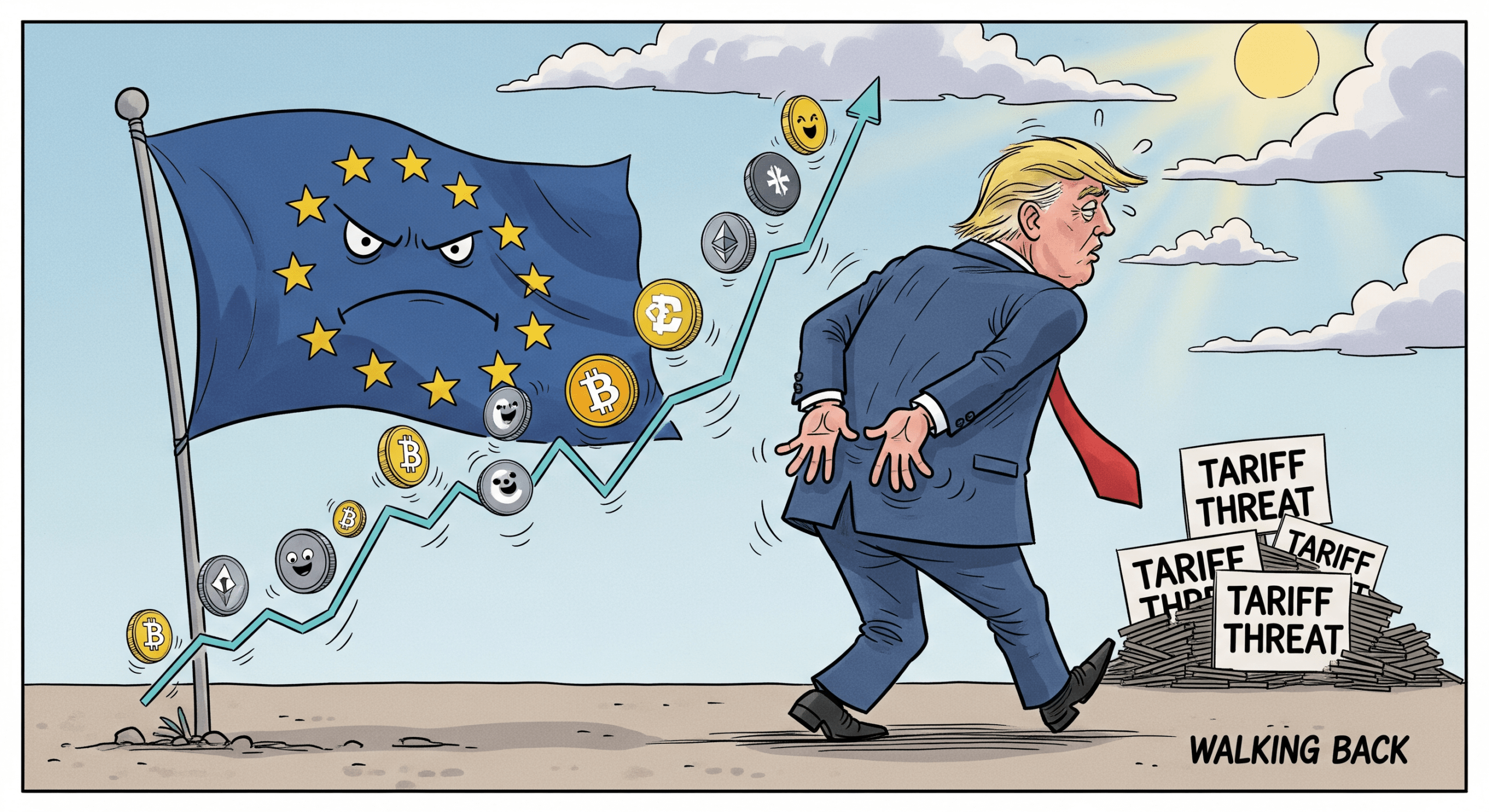
Crypto Market Sees Mild Recovery as Trump Walks Back Tariff Threat on Europe
The crypto market posted modest gains on Thursday following reports that former President Donald Trump softened his stance on potential tariffs targeting the European Union, easing concerns about global trade disruptions that had weighed on risk assets.
Bitcoin climbed 2.3% to $104,850 as of 10:00 AM EST, according to CoinMarketCap data. Ethereum gained 1.8% to reach $3,240, while the total cryptocurrency market capitalization increased by approximately $45 billion to $3.68 trillion over a 24-hour period.
Crypto Market Response to Tariff News
The recovery followed Trump’s comments suggesting a willingness to negotiate with European officials rather than immediately implement sweeping tariffs on EU imports. Bloomberg reported that Trump indicated he would “prefer a deal” with Europe, marking a shift from his previous statements threatening significant trade restrictions.
Trading volume across major exchanges increased by 18% during Asian trading hours, with Binance recording $28.4 billion in 24-hour volume. The market reaction mirrored movements in traditional equities, where European stock indices also posted gains on the tariff news.
Broader Market Context
The crypto market had experienced heightened volatility over the past week amid uncertainty surrounding potential U.S. trade policy changes. Bitcoin had declined 4.7% between January 15-20 as investors moved toward defensive positions.
Major altcoins participated in Thursday’s recovery. Solana advanced 3.1% to $187, while Cardano rose 2.4% to $1.02. XRP gained 1.9% to trade at $2.87, according to CoinGecko data.
Market analysts noted that cryptocurrency assets have shown increased sensitivity to macroeconomic developments in recent months. Reuters reported that institutional trading desks observed correlation patterns between crypto and equity markets strengthening during periods of geopolitical uncertainty.
European Crypto Market Sector Impact
The tariff developments carry particular relevance for Europe’s growing crypto infrastructure. The European Union has implemented comprehensive crypto regulation through its Markets in Crypto-Assets (MiCA) framework, creating a defined regulatory environment for digital asset operations.
European-based crypto platforms reported normal trading activity throughout the volatility period. The region accounts for approximately 23% of global cryptocurrency trading volume, based on industry data compiled by research firms.
Current Crypto Market Sentiment
Derivatives data suggested cautious optimism among traders. Bitcoin futures funding rates remained positive but below levels typically associated with excessive leverage, indicating measured positioning rather than speculative extremes.
The Crypto Fear and Greed Index, which measures market sentiment across multiple factors, moved from 42 (fear) to 51 (neutral) over the 24-hour period.
Read more:-Crypto Market Down Today: What’s Going On?
Outlook
Market participants continue monitoring trade policy developments alongside traditional crypto market drivers including spot Bitcoin ETF flows and upcoming Federal Reserve decisions. January has historically shown mixed performance for digital assets, with no consistent seasonal pattern.
Thursday’s price action occurred against a backdrop of relatively stable on-chain metrics, with Bitcoin active addresses maintaining levels consistent with recent months. The market remains subject to both crypto-specific factors and broader economic conditions affecting risk asset appetite.
FAQ
How do US tariffs impact cryptocurrency exchanges and trading platforms?
While US tariffs do not directly target cryptocurrency exchanges or digital asset trading platforms, they can have an indirect impact on them. Higher tariffs can raise inflation, increase corporate running costs, and generate economic uncertainty, all of which often lead to increased volatility in financial markets, including cryptocurrency. During these times, crypto trading may increase as investors look for other assets. Some platforms might face higher costs for infrastructure, compliance, or technology. This is due to more expensive imported hardware and services. Overall, the influence is indirect, driven primarily by macroeconomic consequences rather than direct regulation of cryptocurrency exchanges.
What is the prediction for crypto in 2026?
dictions for cryptocurrency in 2026 imply that it will continue to expand while remaining volatile. The market is projected to grow as institutional participation increases, laws in key economies improve, and blockchain technology is used for more than just speculation. However, crypto values will continue to be influenced by global economic conditions, legislation, technology advancements, and investor mood, making long-term outcomes uncertain rather than certain.
Disclaimer
This article is for informational purposes only and does not constitute financial or investment advice. Cryptocurrency markets involve risk.This article is for educational purposes only and should not be considered financial advice. Trading cryptocurrencies and other financial instruments carries significant risk, and you could lose all your invested capital. Always do your own research, never invest more than you can afford to lose, and consider consulting with a licensed financial advisor before making investment decisions. Past performance of chart patterns does not guarantee future results.